Industry
Technology
Client
Enterprises
[Blog] AI-DLC vs AI-SDLC: Why Teams Keep Talking Past Each Other

If you listen to how teams talk about AI inside large organizations, it often sounds like everyone agrees—until decisions need to be made.
Engineering says AI is making them faster than ever.
Product says the AI feature is unreliable.
Security and privacy say they can’t approve it.
Leadership asks why spend is increasing while outcomes remain unclear.
Everyone is correct.
They’re just operating in different lifecycles and calling both of them “AI.”
That confusion has quietly become one of the biggest blockers to scaling AI beyond pilots.
Two years ago, this distinction barely mattered. AI was either a backend model or a research project. Foundation models collapsed that boundary. The same systems that help engineers write code are now being embedded directly into products and decision workflows. The language stayed the same. The lifecycle did not.
Two lifecycles, two very different jobs
For clarity, it helps to distinguish between two lifecycles: building software with AI, and building AI into products.
Building with AI (AI-DLC)
This lifecycle is about software delivery velocity.
Here, AI acts as a productivity multiplier for humans. It helps engineers write code faster, generate tests, scaffold features, and explore ideas quickly.
In practice, this lifecycle extends well beyond coding. Product teams use AI to synthesize user interviews and draft requirements. Designers use it to explore concepts and generate variations. QA teams use it to produce test cases and edge-case scenarios. DevOps teams use it to generate infrastructure scripts, dashboards, and runbooks.
What actually lives here: | How success is measured: | Primary risk: |
|---|---|---|
Code generation and refactoring | Cycle time | Maintainability debt |
Product requirement drafts and user research synthesis | Pull request throughput | Code quality drift |
Design exploration and UI scaffolding | Feature velocity | |
Test generation and QA automation | ||
Internal tooling, scripts, and DevOps support | ||
Developer copilots and agentic delivery tools |
Crucially, systems in this lifecycle are not part of the product’s decision surface.
Humans remain accountable for outcomes. Failures are visible and correctable in code.
Building AI products (AI-SDLC)
This lifecycle is about decision reliability.
Here, AI is embedded directly into the product.
It produces outputs or decisions that customers, regulators, or downstream systems rely on.
What actually lives here: | How success is measured: | Primary risk: |
|---|---|---|
LLM-powered product features | Accuracy and consistency | Reliability debt |
Retrieval-augmented decision engines | Behavioral stability over time | Trust erosion |
Agents that take action or make recommendations | Auditability and explainability | Regulatory exposure |
Fine-tuned or custom models |
These systems are non-deterministic by nature.
You cannot unit test them into safety.
They require evaluation, monitoring, and governance as first-class concerns.
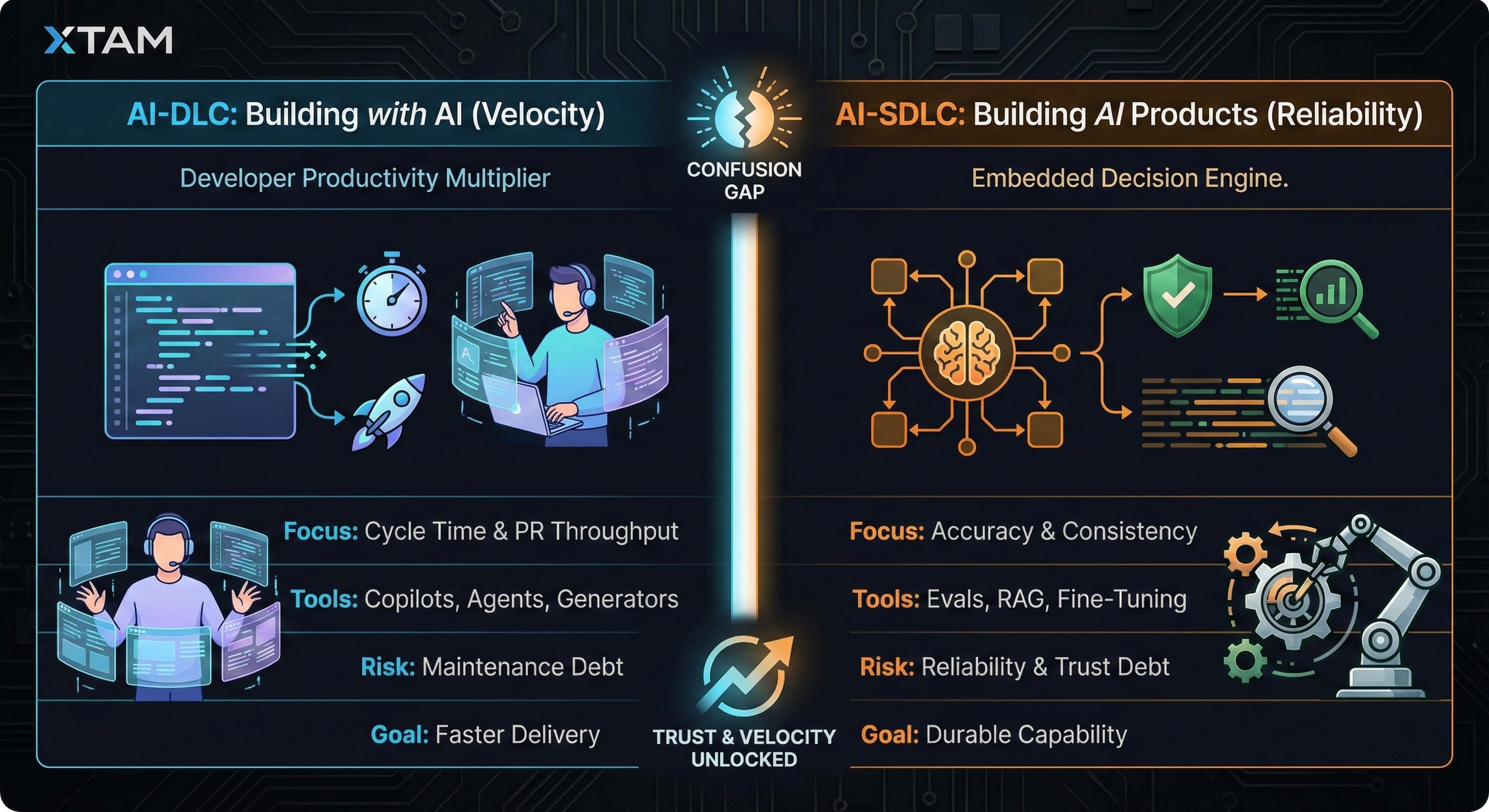
Why teams keep talking past each other
Once you see the split, a lot of internal friction makes sense.
Engineering teams working in the developer lifecycle are right when they say AI is accelerating delivery. They are optimizing for speed, and AI is doing exactly what it should.
Product teams operating in the system lifecycle experience something else entirely. They see inconsistent behavior, edge cases, and user trust issues. Velocity doesn’t help if outcomes vary.
Security and privacy teams are often asked to approve “AI” as a single category. That’s impossible.
With the distinction made explicit, approval lanes become clear.
In the developer lifecycle:
Models are developer tools, not product logic
Data exposure is limited to engineering workflows
Outputs are reviewed by humans before release
Security can focus on vendor access, IP leakage, and developer environment controls.
In the system lifecycle:
Models directly influence product behavior
Data flows include customer or regulated data
Outputs may trigger actions or decisions
Security and privacy evaluate training data provenance, behavior under edge cases, drift, auditability, and rollback mechanisms.
Without this distinction, security teams default to “no,” not because they are blocking progress, but because they are being asked the wrong question.
This is not a governance failure.
It is an architectural mismatch.
The cost of mixing the lifecycles
The difference between these lifecycles isn’t just technical. It’s financial.
Developer-focused AI tends to have fixed, predictable costs—per-seat licenses or bounded usage.
Product-embedded AI does not. Its costs scale with traffic, retries, loops, and behavioral variance. When a system improvises, token consumption improvises with it.
Confusing these two cost models is how AI initiatives quietly blow up P&Ls.
Organizations apply developer-velocity metrics to product systems and wonder why reliability collapses. Or they apply product-grade governance to developer tooling and wonder why velocity dies.
The cost of mixing the lifecycles is predictable: stalled pilots, governance bottlenecks, and teams blaming one another.
How organizations get stuck
Most organizations today fall into one of two broken states.
Performance acceleration without product expansion.
Engineering is faster than ever. AI features never leave pilot. Product sees inconsistent behavior. Security blocks releases. Leadership sees spend without revenue impact. The organization is optimized for speed, not trust.
Product ambition without lifecycle rigor.
Leadership wants AI in the product. Teams treat it like normal software. There is no evaluation strategy, no behavioral monitoring, and no clear ownership of model risk. The result is fragile launches, rollbacks, and loss of confidence.
In both cases, the issue is not talent or tooling.
It’s the absence of a clear AI-SDLC.
Separation first, integration second
Organizations that eventually scale AI arrive at the same structure, whether intentionally or not.
They separate the lifecycles first, then connect them deliberately.
In practice, this means:
Labeling workstreams clearly before projects start
Measuring velocity in the developer lifecycle and reliability in the system lifecycle
Giving security and privacy clear, lifecycle-specific approval criteria
Only then do the two lifecycles reinforce each other.
For example:
In the developer lifecycle, an engineer might use an agent to generate a comprehensive test suite for a new workflow. In the system lifecycle, that same test suite becomes the evaluation harness that gates whether an AI feature can ship.
This is how experimentation turns into production without sacrificing speed or trust.
How to tell if you’re facing this problem today
Ask two questions internally:
Are we celebrating developer speed while AI features stall in pilot?
Are we shipping AI features that work, but only with constant human oversight?
If the answer to either is yes, you don’t have a model problem.
You have a lifecycle problem.
The takeaway
Building with AI and building AI products are not competing philosophies.
They are complementary disciplines with different rules.
Organizations that fail to separate them end up with faster engineers and unreliable products.
Organizations that do separate them unlock both velocity and trust.
That distinction—not the choice of model or vendor—is what determines whether AI becomes a durable capability or a perpetual experiment.
Think you have a lifecycle problem? Let us help.
Let’s schedule a 30-minute whiteboard session.
No pitch decks. No sales slides. Just a rigorous, honest diagnostic of your current state to pinpoint exactly why your AI initiatives are stalling—and how to clear the path to production.
Let's talk