Industry
Technology
Client
Enterprises
[Blog] The Irrational Fear of Custom AI

Why Playing It Safe Is Often the Riskiest Move
Across large enterprises, a familiar moment repeats itself.
A leadership team agrees that AI should play a meaningful role in how the organization operates—not as a pilot or a novelty, but as part of real decision-making and real workflows. There is alignment. There is momentum. There is budget.
Then someone asks the next question:
“Are we talking about something custom?”
The room usually goes quiet.
For many CIOs and CTOs, custom AI is perceived as heavy, risky, and difficult to maintain. The instinctive response is to look for something safer: a commercial model, a retrieval layer, or a configuration that promises value without the burden of ownership.
The Problem With “Retrieval-Only Thinking”
That instinct is understandable. It is also one of the most common reasons enterprise AI initiatives stall.
In practice, the “safe” choice—relying entirely on off-the-shelf models and retrieval—often turns out to be the riskier operational move. By avoiding customization, organizations are not reducing risk. They are:
Capping their potential capability
Ignoring the long-term economics of production AI
Pushing ownership into opaque systems they do not fully control
Most organizations start with a reasonable goal: use AI to support complex, repeatable decisions that depend on context and institutional knowledge.
The standard implementation is almost always retrieval-driven. Policies, documents, and historical records are indexed, and the system is designed to surface the right information at the right time. Early results usually look promising. The system answers questions, summarizes documents, and appears informed.
Then the scope expands.
As teams move from simple reference tasks to complex judgment calls, the gaps begin to appear.
We see this repeatedly. A critical input is not retrieved. Two sources conflict. The model, lacking any understanding of business priorities, produces an answer that is technically defensible but operationally wrong. It follows the documented letter of the policy while violating its intent.
This happens because retrieval systems are optimized for recall, not judgment.
They assume that if the relevant information is provided, the correct decision will naturally follow. That assumption holds for search engines.
It does not hold for expert decision-making.
Separating the Reasoning from the Reference
Addressing this requires a shift in architecture.
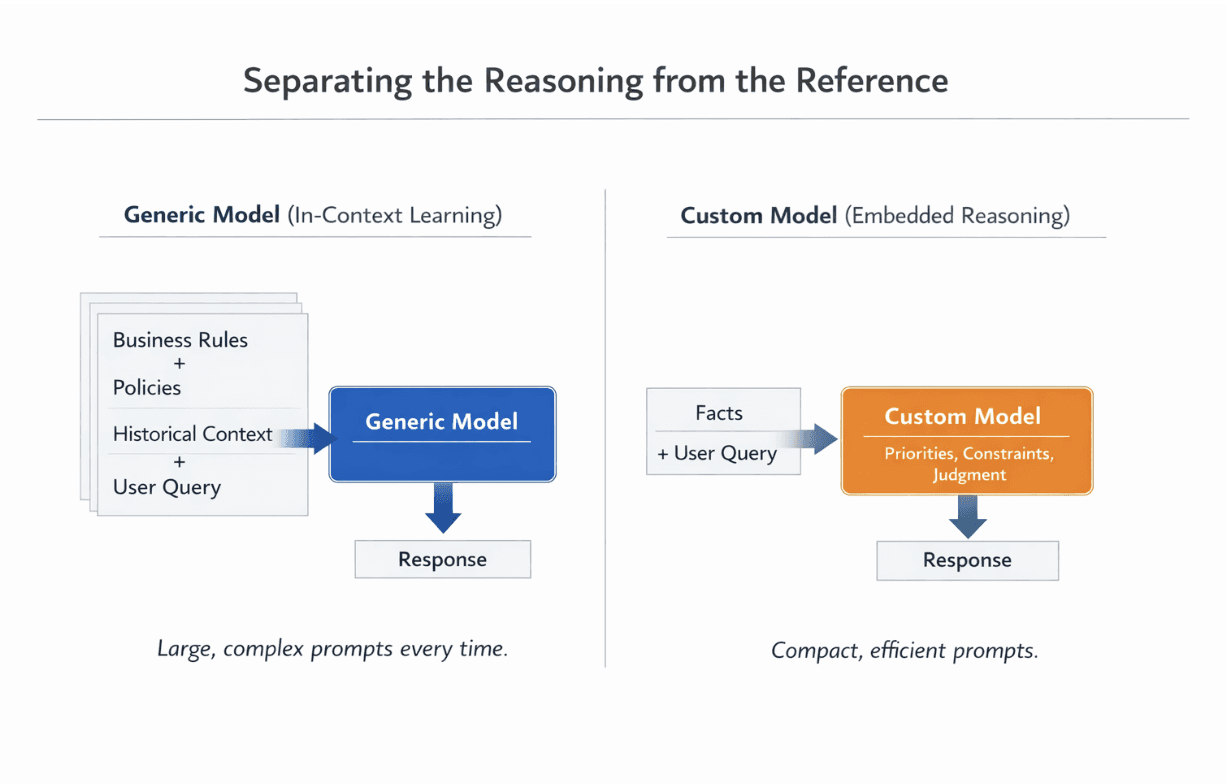
A more durable approach separates the system into two distinct roles: the model and the retrieval layer.
The custom model is where reasoning lives. It learns the stable parts of the business—how signals should be weighed, how ambiguity should be resolved, and how consistency should be maintained under uncertainty. The goal is not to teach the model facts. The goal is to teach it behavior.
The retrieval layer supplies the variables. It handles the facts, records, policy numbers, and contextual details that change over time.
When these roles are clearly separated, systems become far more reliable. The model reasons. The retrieval layer informs. The system no longer needs to reread the manual every time it is asked to make a decision, because the core logic is already embedded.
This does not imply that all business logic belongs in model weights, or that models must be retrained for every policy change. In practice, enterprises distinguish between stable decision frameworks and variable parameters.
Custom models internalize the former. Retrieval systems and configuration layers handle the latter. Getting this boundary right is what separates durable systems from brittle ones.
Why This Is Critical for Agents
This distinction becomes even more important as organizations move toward agentic AI.
An agent is not just a chatbot. It is a system expected to act, choose among options, and adapt to outcomes over time. For an agent to work effectively, it must understand priorities and constraints before it selects a tool or takes an action.
When judgment exists only in prompts or retrieved documents, agents become brittle. They overuse tools, misinterpret instructions, or fail when conditions deviate from the expected path.
When judgment is embedded in a custom model, tools become amplifiers rather than crutches. The agent knows when to gather more information, when to act, and when to escalate because procedural knowledge is part of the model itself.
This is the difference between automation that reacts and systems that behave intelligently.
Rethinking the Economics
Cost is often the final objection to custom AI, and it is frequently evaluated backward.
There is an upfront investment to train or fine-tune a model to reason correctly within a specific domain. That cost is visible and finite.
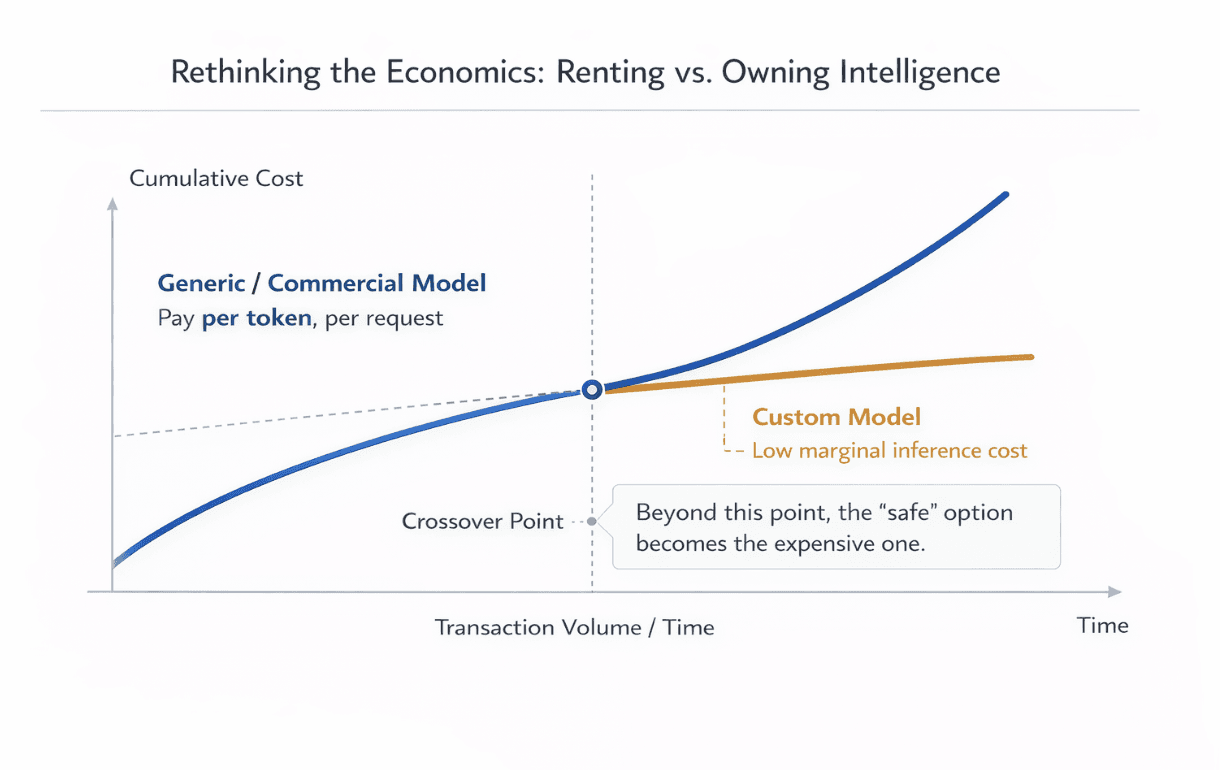
What is less visible is the ongoing operational cost of relying on generic models. Large prompts, repeated context, and expanding usage-based pricing create a compounding expense. Organizations effectively rent intelligence while paying to restate the same instructions on every interaction.
Custom models change this cost profile. Core logic is embedded once. Prompts shrink. Inference becomes faster and cheaper. Costs stabilize as usage grows.
In many high-volume enterprise environments, the option that appears conservative at the start becomes the most expensive over time.
AI is rapidly becoming operational infrastructure rather than experimental tooling. Infrastructure demands clarity about where intelligence belongs, how decisions are made, and who owns the outcome.
The choice is not between off-the-shelf systems and custom models. It is between systems that appear intelligent and systems that can actually do the job under real-world conditions.
For many enterprises, the greater risk is not building something custom. It is assuming that retrieval alone can substitute for judgment.